AuDHD in adult women: why assessment models struggle with this intersection
Understand the challenges of assessing co-occurring ADHD and autism (AuDHD) in adult women, and why integrated approaches are needed in clinical practice.
Co-occurring autism and ADHD (sometimes referred to as AuDHD or autism-ADHD comorbidity) is increasingly recognised in adult clinical practice.
In England, demand for adult ADHD assessment has grown sharply, partly because of diagnoses missed earlier in life, especially in women (NHS England ADHD Taskforce, 2025). Autism and ADHD also often occur together: a meta-analysis by Lai and colleagues (2019) estimated that around 28% of autistic people also have ADHD.
In practice, this overlap is becoming more common, particularly in adult women presenting for assessment.
What is AuDHD?
AuDHD refers to the co-occurrence of autism and ADHD within the same individual.
The two conditions do not simply sit side by side. Antshel and Russo (2019) describe overlapping difficulties in attention, executive function and social functioning when both are present, which shape everyday experience differently from either condition alone.
This has important implications for how assessment is approached in adults, particularly in women, where presentations are often less aligned with traditional diagnostic models.
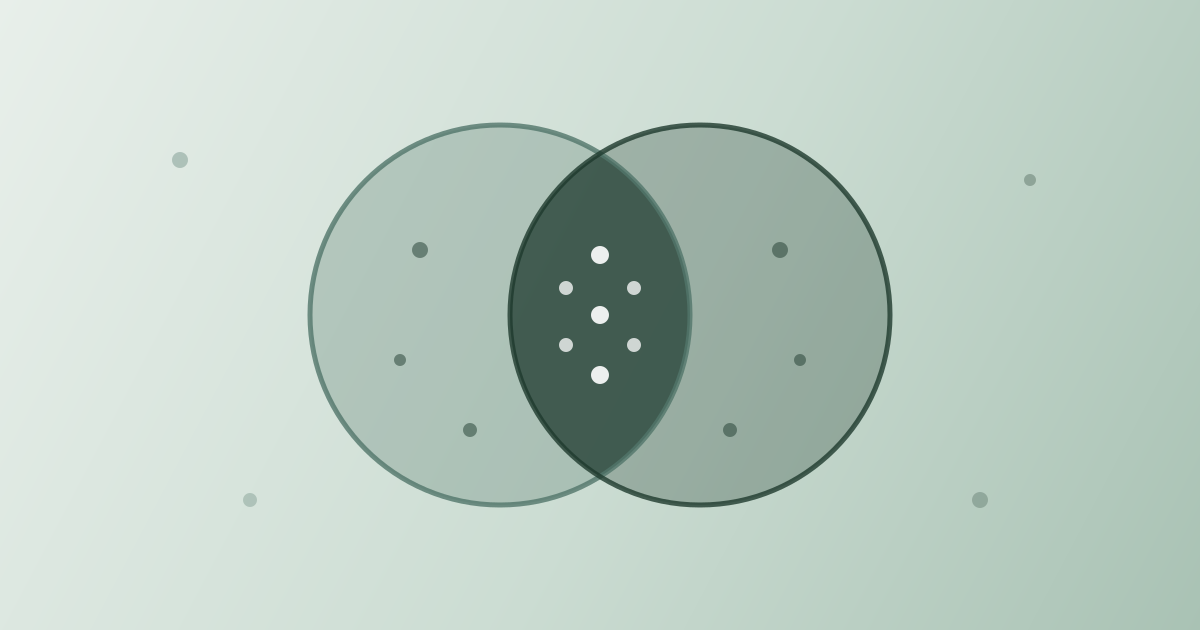
More than two conditions side by side
When autism and ADHD are both present, they interact, shaping how traits appear, how individuals cope and how difficulties are experienced.
Reviews of cognitive and brain studies point the same way. Rommelse and colleagues (2011) describe cognitive and neurobiological markers shared by autism and ADHD, which suggests a partly shared neurodevelopmental profile rather than two conditions that simply add up.
Why current assessment pathways struggle
When autism and ADHD co-occur, traits can mask or reshape each other.
For example:
- ADHD-related impulsivity may obscure autistic routines
- Rigid structures may be used to compensate for attentional dysregulation
- Hyperfocus may act as a form of self-regulation
- Social masking may reduce the visibility of both
This can result in presentations that appear inconsistent or subthreshold across both frameworks.
When traits interact, visibility decreases
When both conditions are considered in isolation, this interaction can reduce trait visibility across each diagnostic pathway.
Patterns may appear partial in each framework, even when the overall neurodevelopmental profile is clear in longitudinal and cross-domain clinical data.
The added complexity in adult women
For women this becomes more complex still: social expectations, masking and long-term adaptation can produce presentations that do not align clearly with traditional diagnostic models.
Some women report receiving multiple diagnoses over time, without feeling that any single framework fully captures their experience.
This reflects a limitation in how current systems categorise neurodevelopmental profiles, rather than a lack of clarity on the individual's part.
A structural gap in assessment
When ADHD and autism are treated as separate questions, the integration work often falls on the individual.
They are left to:
- Connect patterns across time
- Reconcile different diagnostic outcomes
- Make sense of overlapping traits
This contributes to long routes to diagnosis and delayed clarity.
Towards more integrated approaches
Improving assessment for AuDHD does not necessarily require entirely new tools.
But it does require:
- Holding both conditions in mind simultaneously
- Integrating information across domains
- Recognising how traits interact, not just how they present in isolation
A more integrated approach may reduce the multi-year diagnostic cycles often seen in adult women.
Supporting clinicians in this complexity
At Lira, we are exploring how to support clinicians working in this space.
Lira for Professionals provides a structured approach to ADHD and autism assessment in adult women, helping to:
- Integrate information across domains
- Map traits consistently to DSM-5 criteria
- Capture patterns that may not fit neatly into a single framework
The aim is more consistent assessment, with clinical judgement staying with the clinician.
Explore the approach
If you are working with adult women and seeing this overlap in practice:
See how Lira for Professionals structures the assessment →
References
- NHS England (2025). Report of the independent ADHD Taskforce: Part 1. england.nhs.uk
- Lai, M.-C., Kassee, C., Besney, R., Bonato, S., Hull, L., Mandy, W., Szatmari, P., & Ameis, S. H. (2019). Prevalence of co-occurring mental health diagnoses in the autism population: A systematic review and meta-analysis. The Lancet Psychiatry, 6(10), 819-829. doi:10.1016/S2215-0366(19)30289-5
- Antshel, K. M., & Russo, N. (2019). Autism spectrum disorders and ADHD: Overlapping phenomenology, diagnostic issues, and treatment considerations. Current Psychiatry Reports, 21(5), 34. doi:10.1007/s11920-019-1020-5
- Rommelse, N. N. J., Geurts, H. M., Franke, B., Buitelaar, J. K., & Hartman, C. A. (2011). A review on cognitive and brain endophenotypes that may be common in autism spectrum disorder and attention-deficit/hyperactivity disorder and facilitate the search for pleiotropic genes. Neuroscience and Biobehavioral Reviews, 35(6), 1363-1396. doi:10.1016/j.neubiorev.2011.02.015
Related articles
Autism assessment in adult women: challenges and clinical considerations
How autism presents differently in adult women, what masking does to the assessment, and where standard instruments fall short.
What thirty days of daily records add to an ADHD or autism assessment
Retrospective self-report fails in predictable ways in adults who have spent years masking. A prospective daily record is a different class of evidence. What it shows, how much is enough, and what it must never be used for.

Why adult ADHD and autism assessments still take hours
Why ADHD and autism assessments in adults still take hours, and what is missing from the clinical workflow, particularly for women.